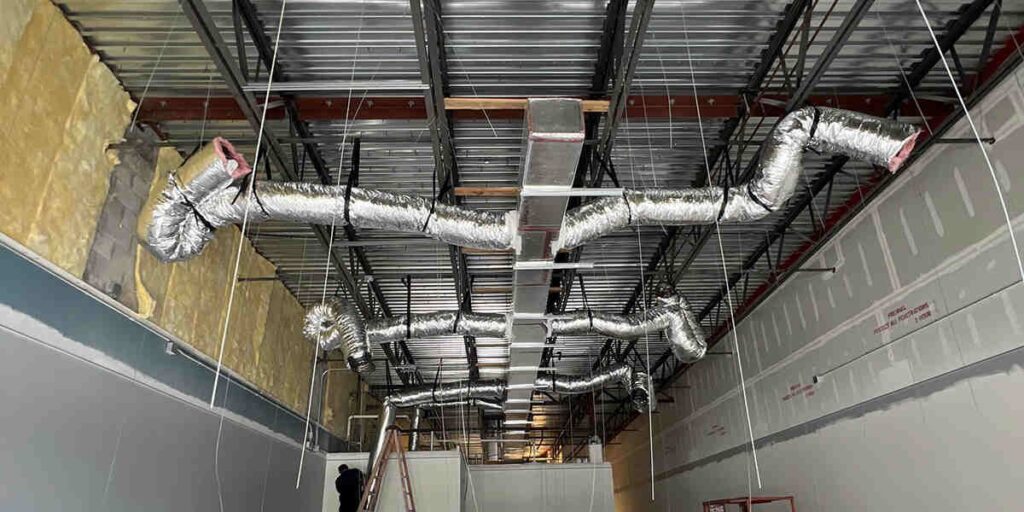
Flexible air ducts in Kenya for industrial ventilation.
Flexible air ducts, commonly called flex ducts, are lightweight tubes designed to carry air through ventilation systems. Manufacturers produce them using different materials, depending on the intended application.
1. Air movement begins: A fan, air handling unit or other suitable equipment creates the pressure difference needed to move air.
2. Air enters the duct: The duct receives air from the equipment or a connected section of ductwork.
3. Air travels through the duct: The flexible tube directs airflow along the selected route
4. Air reaches its destination: Supply ducts deliver air through diffusers or grilles. Exhaust ducts carry unwanted air towards an approved discharge point.
5. The system maintains airflow: Proper duct sizing, secure connections and suitable fan capacity help achieve the required ventilation rate.
First, assess the ventilation requirements, prepare installation route, measure and cut the duct, connect the duct securely and finally support the duct properly and lastly test the system.
Small exhaust fans and compact ventilation connections
Larger airflow connections and some commercial installations
These are indicative examples, not fixed capacity ratings.
General room ventilation and selected HVAC branches
Selected large-volume ventilation systems
A 150 mm duct, for instance, cannot be assigned a reliable airflow rate based on diameter alone.
Inspect duct surfaces. Check connections. Remove obstructions. Checking airflow. Inspect Condensation. Servicing ventilation equipment. Replacing damaged ducts.
Weak airflow. Air leakage. Excessive noise. Condensation. Dust accumulation. Short service life.