
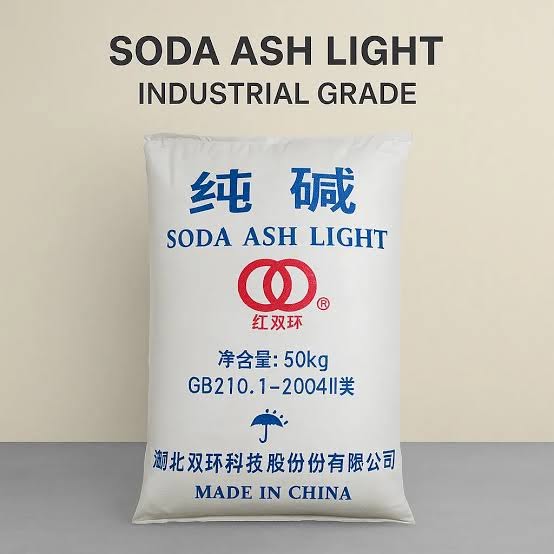
Soda ash in Kenya
Soda ash in Kenya, chemically known as sodium carbonate (\(\mathrm{Na_2CO_3}\)), is an alkaline industrial chemical widely used in water treatment, glass manufacturing, detergent production, textile processing and chemical manufacturing. It appears as a white, odourless powder, crystalline material or fine granules. Moreover, soda ash dissolves readily in water and produces an alkaline solution that helps regulate pH, neutralise acidic substances and soften hard water. Its chemical identification number is CAS 497-19-8, while its molecular mass is approximately 105.99 g/mol. Depending on the intended application, manufacturers supply soda ash in light and dense grades. Light soda ash has a lower bulk density and suits applications that require easy dissolution and mixing. In contrast, dense soda ash offers higher bulk density, making it suitable for industrial handling, storage and automated dosing systems.
Description
SODA ASH IN KENYA
Soda ash in Kenya, chemically known as sodium carbonate {Na_2CO_3}, is an alkaline industrial chemical widely used in water treatment, glass manufacturing, detergent production, textile processing and chemical manufacturing. It appears as a white, odourless powder, crystalline material or fine granules. Moreover, soda ash dissolves readily in water and produces an alkaline solution that helps regulate pH, neutralise acidic substances and soften hard water. Its chemical identification number is CAS 497-19-8, while its molecular mass is approximately 105.99 g/mol. Depending on the intended application, manufacturers supply soda ash in light and dense grades. Light soda ash has a lower bulk density and suits applications that require easy dissolution and mixing. In contrast, dense soda ash offers higher bulk density, making it suitable for industrial handling, storage and automated dosing systems.
Technical Properties and Chemical Behaviour
Soda ash exhibits stable chemical properties under recommended storage conditions. Its alkaline nature makes it particularly useful in processes that require controlled pH adjustment. When dissolved in water, sodium carbonate produces carbonate and bicarbonate species, which contribute to alkalinity. Consequently, water treatment operators use it to raise pH and manage water hardness. Furthermore, soda ash reacts with acids to produce carbon dioxide, water and corresponding salts. This reaction makes it useful for neutralising acidic process streams when operators calculate and control the required dosage. Pure sodium carbonate has a solid density of approximately 2.5 g/cm³, a melting point of about 851°C and a water solubility of approximately 212 g/L at 20°C. However, actual performance depends on product purity, temperature, concentration and water chemistry. Therefore, industrial buyers should check the manufacturer’s technical data sheet before selecting a grade for a specific process.
Major Industrial Applications of Soda Ash In Kenya
Soda ash serves several important functions across different industrial sectors. In water treatment, it raises pH, supports water softening and helps maintain suitable conditions for subsequent treatment processes. Additionally, manufacturers use it in glass production because it lowers the melting temperature of silica, thereby improving processing efficiency. In detergent manufacturing, soda ash provides alkalinity, assists grease removal and reduces the effects of water hardness. Similarly, textile processors use it to establish alkaline conditions during selected dyeing and fabric-treatment operations.
Moreover, the chemical industry uses soda ash to manufacture other sodium compounds and various industrial formulations. Pulp and paper manufacturers also use it in selected chemical processing applications. In addition, certain industrial drilling operations use soda ash to control calcium contamination and adjust the chemistry of water-based drilling fluids. Nevertheless, the correct grade and dosage depend on the process requirements and the manufacturer’s specifications.
Although soda ash is non-combustible, its alkaline properties can irritate the eyes, skin and respiratory tract. Therefore, workers should wear suitable protective gloves, safety goggles and appropriate respiratory protection wherever airborne dust may occur. Furthermore, operators should use adequate ventilation and avoid generating unnecessary dust during handling and mixing. If the chemical enters the eyes, rinse immediately with plenty of clean water and seek medical attention as indicated by the safety data sheet.
For safe storage, keep soda ash in tightly sealed packaging within a cool, dry and well-ventilated area. In addition, protect the material from moisture and incompatible substances, particularly acids. Finally, follow the manufacturer’s safety data sheet, handling instructions and recommended dosing procedures to maintain product quality and workplace safety.



Reviews
There are no reviews yet.