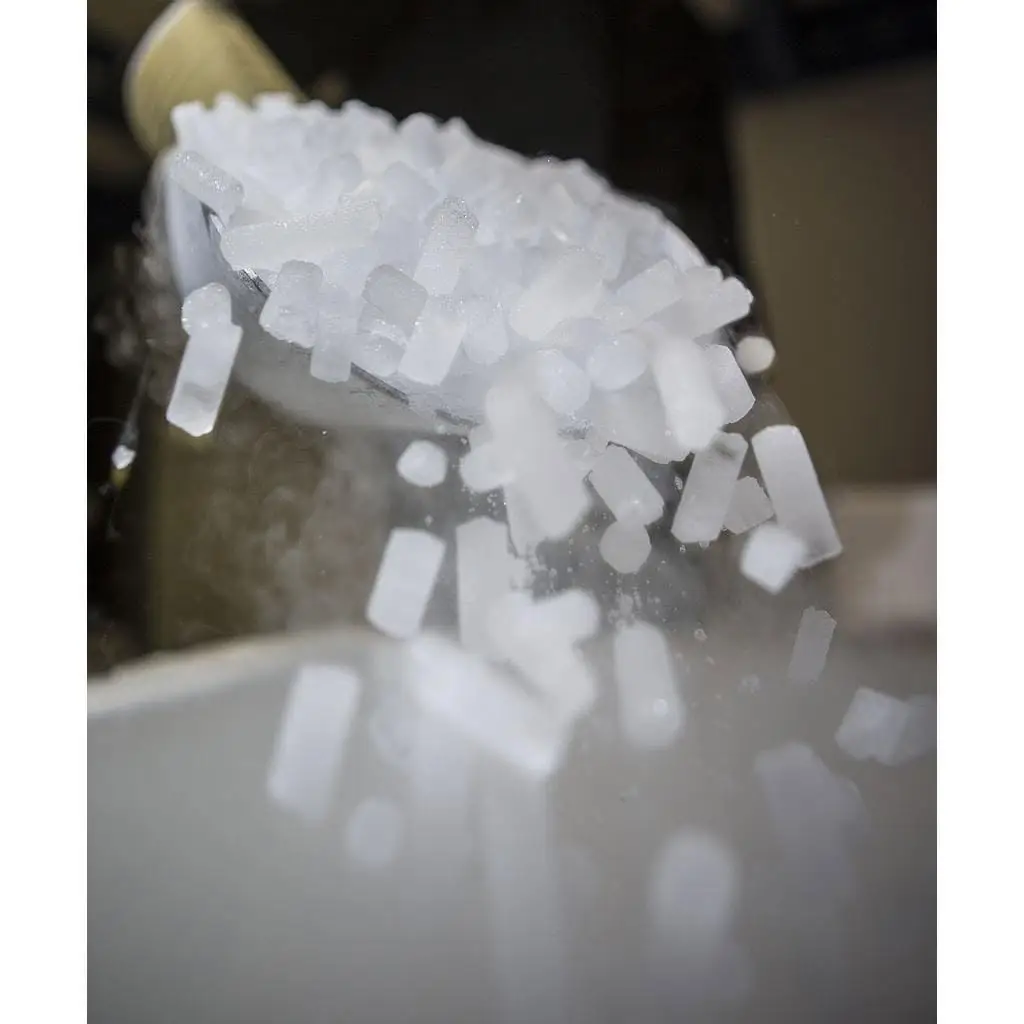
Uses and Applications of Dry Ice: A Technical and Comprehensive Guide
Introduction to Dry Ice
Dry ice is the solid form of carbon dioxide (CO₂), a colourless, odourless gas that occurs naturally in the atmosphere. Unlike conventional ice, which consists of frozen water, dry ice changes directly from a solid into a gas through a process known as sublimation. Consequently, it does not produce liquid water as it melts. This unique characteristic makes dry ice particularly useful in applications that require powerful cooling, temperature control, food preservation, industrial cleaning and specialised manufacturing processes.
Dry ice maintains a temperature of approximately -78.5°C at atmospheric pressure. Therefore, it provides significantly lower temperatures than ordinary water ice. Moreover, its sublimation process allows it to cool products without introducing moisture into the surrounding environment. This advantage makes dry ice suitable for transporting temperature-sensitive products, preserving perishable goods and supporting industrial operations.
Today, businesses across the food processing, pharmaceutical, healthcare, logistics, manufacturing and entertainment industries use dry ice to improve operational efficiency. Additionally, its ability to produce controlled cooling and non-abrasive cleaning makes it an important material in modern industrial applications.
1. Food Preservation and Cold Chain Transportation
Primary SEO keywords: Dry ice for food preservation, dry ice transportation, dry ice for frozen food, cold chain packaging.
One of the most important applications of dry ice involves preserving food products during storage and transportation. Because dry ice maintains extremely low temperatures, it helps prevent bacterial growth, slows food deterioration and preserves product quality.
Food distributors, manufacturers, supermarkets and catering businesses use dry ice to maintain frozen conditions throughout the supply chain. Unlike conventional ice, dry ice does not release liquid water. Therefore, it protects food packaging from moisture damage while maintaining the required cooling environment.
Common food preservation applications include:
- Meat and poultry transportation: Dry ice maintains frozen conditions during the transportation of beef, chicken, pork and other meat products.
- Seafood preservation: Fish, prawns, crabs and other seafood products require strict temperature control to maintain freshness and quality.
- Frozen food distribution: Manufacturers use dry ice when transporting frozen vegetables, processed foods, ready-made meals and other frozen products.
- Ice cream transportation: Dry ice helps maintain low temperatures when distributing ice cream and other frozen desserts.
- Bakery and confectionery products: Businesses use dry ice to transport temperature-sensitive chocolate, specialised desserts and certain frozen bakery products.
- Food export operations: Exporters use dry ice in appropriately designed insulated packaging to maintain frozen conditions during transportation.
Furthermore, dry ice supports businesses that distribute frozen products over long distances, particularly where conventional refrigeration infrastructure may be limited.
2. Pharmaceutical and Medical Applications
Primary SEO keywords: Dry ice for pharmaceutical transportation, medical cold chain, dry ice for vaccine storage, biological sample preservation.
The pharmaceutical and healthcare industries require reliable temperature control to preserve the quality and stability of sensitive materials. Some medicines, laboratory reagents and biological specimens deteriorate when exposed to temperatures outside their approved storage ranges.
Dry ice provides an effective cooling medium for transporting selected temperature-sensitive pharmaceutical products. Its extremely low temperature makes it particularly useful where frozen transportation conditions are necessary.
Important applications include:
- Pharmaceutical distribution: Pharmaceutical companies use dry ice to transport selected medicines that require frozen conditions.
- Biological sample transportation: Laboratories use dry ice to preserve tissue specimens, biological materials and other temperature-sensitive samples.
- Vaccine transportation: Certain vaccine formulations and specialised medical products require ultra-low-temperature handling. Dry ice can support transportation where the manufacturer’s specified temperature range permits its use.
- Laboratory reagents: Research institutions use dry ice to maintain the stability of temperature-sensitive chemicals and biological reagents.
- Clinical research: Medical research organisations use dry ice when transporting specimens between hospitals, laboratories and research facilities.
- Diagnostic sample preservation: Selected diagnostic materials require controlled freezing during transportation to maintain sample integrity.
However, pharmaceutical transportation requires strict temperature monitoring, validated packaging and compliance with applicable handling procedures. Dry ice should not automatically replace refrigerated storage because different medicines have different temperature requirements.
3. Industrial Cleaning Through Dry Ice Blasting
Primary SEO keywords: Dry ice blasting, industrial dry ice cleaning, dry ice cleaning equipment, non-abrasive industrial cleaning.
Dry ice blasting is one of the most valuable industrial applications of dry ice. This cleaning technology uses compressed air to accelerate small dry ice pellets towards contaminated surfaces. When the pellets strike a surface, their kinetic energy loosens dirt, grease, oil, carbon deposits and other unwanted materials.
Additionally, the dry ice undergoes rapid sublimation after impact. As a result, the cleaning process does not leave secondary water or abrasive blasting residue.
Industries use dry ice blasting for several cleaning operations.
A. Cleaning industrial machinery
Manufacturing plants use dry ice blasting to remove accumulated grease, oil, dust, adhesives and production residues from machinery. Consequently, maintenance teams can clean selected equipment without introducing water into sensitive mechanical assemblies.
B. Electrical equipment cleaning
Dry ice blasting can clean selected electrical components, control panels and industrial equipment when technicians follow appropriate electrical isolation and safety procedures. Since the process does not introduce cleaning water, it can reduce moisture-related contamination risks.
C. Cleaning moulds and production equipment
Plastic manufacturers, rubber processors and food production companies use dry ice blasting to clean moulds, production tools and processing equipment. It removes accumulated contaminants while reducing the need for abrasive cleaning methods.
D. Automotive and engineering applications
Automotive workshops and engineering facilities use dry ice blasting to remove grease, underbody contaminants, oil deposits and dirt from selected vehicle components.
E. Food processing equipment
Food manufacturers use dry ice blasting to remove stubborn production residues from conveyors, ovens, mixers and processing machinery. However, they must still follow applicable food hygiene requirements and verify that the cleaning process achieves the required sanitation standard.
Dry ice blasting offers several advantages:
- It does not introduce cleaning water.
- It leaves no secondary blasting media.
- It reduces abrasive damage to suitable surfaces.
- It can reach difficult areas and complex equipment geometries.
- It can reduce equipment disassembly and cleaning downtime.
- It supports maintenance in specialised industrial environments.
Nevertheless, dry ice blasting requires specialised equipment, compressed air and trained operators.
4. Industrial Cooling and Temperature Control
Primary SEO keywords: Industrial cooling with dry ice, dry ice cooling applications, solid carbon dioxide cooling.
Dry ice provides rapid cooling in industrial environments that require temperatures below those achievable with conventional ice. Its extremely low temperature makes it suitable for temporary cooling, experimental processes and specialised production activities.
Industries apply dry ice in the following areas:
- Cooling industrial materials: Manufacturers use dry ice to cool selected materials during processing.
- Temperature-sensitive production: Certain manufacturing operations require controlled cooling to protect materials from excessive heat.
- Equipment maintenance: Technicians use dry ice to cool selected components during specialised maintenance operations.
- Laboratory experiments: Research laboratories use dry ice to achieve low temperatures during scientific experiments.
- Thermal testing: Engineers use dry ice in controlled temperature tests involving materials and components.
- Emergency cooling: Industrial operators may use dry ice as a temporary cooling medium when conventional cooling systems become unavailable, provided the process permits its use.
Furthermore, dry ice can support specialised applications where water contamination would interfere with product quality or production requirements.
5. Transportation of Temperature-Sensitive Products
Primary SEO keywords: Dry ice shipping, dry ice cold chain logistics, dry ice insulated containers, dry ice for product delivery.
The logistics industry uses dry ice to transport products that require frozen or ultra-low-temperature conditions. Its high cooling capacity makes it particularly useful for businesses handling products that travel over long distances.
Companies commonly combine dry ice with insulated cooler boxes, expanded polystyrene (EPS) containers and specialised thermal packaging.
Applications include:
- Transportation of frozen meat and seafood.
- Delivery of ice cream and frozen desserts.
- Distribution of selected pharmaceutical products.
- Shipment of biological specimens.
- Transportation of laboratory materials.
- Distribution of frozen food ingredients.
- Export of temperature-sensitive products.
Moreover, dry ice can help businesses maintain product quality during temporary interruptions in the cold chain. However, the quantity required depends on the product, packaging insulation, shipment duration, external temperature and expected sublimation rate.
For commercial logistics, operators must also comply with applicable dangerous-goods transportation requirements because dry ice releases carbon dioxide gas during sublimation.
6. Special Effects, Entertainment and Event Production
Primary SEO keywords: Dry ice for special effects, dry ice fog, dry ice smoke effects, dry ice for events.
Dry ice has significant applications in entertainment, photography, film production and event management. When operators place dry ice in warm water, it sublimates rapidly and produces dense carbon dioxide-rich vapour that creates a low-lying fog effect.
This effect is particularly popular because the fog remains close to the ground under suitable conditions, creating a distinctive visual atmosphere.
Common applications include:
- Weddings: Event organisers use dry ice to create a cloud-like effect around dance floors and entrances.
- Concerts: Production teams use dry ice effects to enhance stage presentations.
- Film production: Film crews use dry ice to create atmospheric scenes and controlled fog effects.
- Photography: Photographers use dry ice effects for creative studio sessions and product photography.
- Theatre productions: Stage designers use dry ice to produce dramatic atmospheric effects.
- Corporate events: Event planners use dry ice to enhance product launches, exhibitions and presentations.
However, operators must ensure adequate ventilation because carbon dioxide can accumulate in enclosed or low-lying spaces. They should also prevent direct contact with dry ice and avoid placing it in sealed containers.
7. Pest Control and Fumigation Applications
Primary SEO keywords: Dry ice pest control, dry ice for rodent control, carbon dioxide pest management.
Dry ice has specialised applications in pest management, particularly in certain controlled rodent-control operations. Its sublimation releases carbon dioxide, which can displace oxygen within an appropriately prepared and enclosed burrow system.
Professional pest-control operators may use this characteristic in authorised treatments targeting specific underground rodent populations.
However, this application requires technical knowledge, proper site assessment and compliance with relevant environmental and pest-control regulations. It is not a general-purpose pest-control solution and should not be attempted by untrained individuals.
Additionally, dry ice should never be used in occupied spaces or poorly ventilated buildings as a means of controlling pests.
8. Construction and Civil Engineering Applications
Primary SEO keywords: Dry ice in construction, dry ice concrete cooling, industrial construction cooling.
The construction industry uses dry ice in selected specialised applications that require temporary cooling or controlled temperature reduction.
For example, concrete producers and contractors may use dry ice to reduce the temperature of concrete constituents under demanding hot-weather concreting conditions. Lower concrete temperatures can help manage the risk of excessive early hydration temperatures and improve temperature control during placement.
Other applications include:
- Cooling selected construction materials during specialised processing.
- Supporting temperature-sensitive laboratory testing of construction materials.
- Cooling certain mechanical components during maintenance.
- Supporting specialised engineering experiments.
- Temperature management in selected industrial construction operations.
However, dry ice does not serve as a direct substitute for conventional concrete cooling systems in every project. Engineers must calculate the required cooling capacity and evaluate the effects of temperature changes on the materials and construction process.
9. Chemical and Scientific Research Applications
Primary SEO keywords: Dry ice for laboratory experiments, dry ice chemical applications, dry ice scientific research.
Dry ice plays an important role in scientific research because it provides a convenient source of extremely low temperatures. Researchers use it in chemistry, biology, physics and material science laboratories.
Its applications include:
- Low-temperature chemical reactions: Researchers use dry ice to maintain cooling conditions during selected chemical reactions.
- Sample preservation: Laboratories use dry ice to preserve temperature-sensitive research specimens.
- Solvent cooling: Scientists use dry ice with compatible solvents to create cooling baths for specialised laboratory procedures.
- Material testing: Researchers use it to examine how selected materials respond to low temperatures.
- Cryogenic preparation: Dry ice supports certain preliminary cooling processes, although it does not reach the temperatures of liquid nitrogen.
- Carbon dioxide experiments: Researchers use dry ice to investigate sublimation, gas behaviour and heat transfer.
Furthermore, dry ice offers laboratories a practical cooling option where conventional refrigeration cannot provide the required temporary temperature conditions.
10. Metalworking, Engineering and Shrink Fitting
Primary SEO keywords: Dry ice for metalworking, dry ice shrink fitting, industrial metal cooling, dry ice engineering applications.
Dry ice has specialised applications in metalworking, mechanical engineering and equipment assembly. Its extremely low temperature allows engineers to cool selected metal components rapidly and achieve temporary dimensional changes.
One important application is shrink fitting. This process involves cooling a metal component to reduce its dimensions before fitting it into another component. Once the cooled component returns to normal temperature, it expands and forms a tight mechanical connection.
Common applications include:
- Fitting shafts into bearing assemblies.
- Installing metal bushes and sleeves.
- Assembling selected mechanical components.
- Installing precision-engineered parts.
- Cooling selected metal components during maintenance.
- Supporting specialised engineering and manufacturing processes.
For example, an engineering workshop may use dry ice to cool a metal shaft before inserting it into a bearing housing. The temporary contraction makes assembly easier and can reduce the need for excessive mechanical force.
However, engineers must consider material properties, dimensional tolerances and thermal stresses before applying this technique.
11. Rubber, Plastics and Polymer Processing
Primary SEO keywords: Dry ice for rubber processing, dry ice for plastics, cryogenic rubber processing, industrial polymer applications.
Dry ice also supports selected rubber and plastic manufacturing processes. Its low temperature can make certain polymers and rubber compounds brittle, allowing manufacturers to process or separate materials more efficiently.
One specialised application involves cryogenic grinding. In this process, manufacturers expose selected rubber or plastic materials to extremely low temperatures before mechanically grinding them into smaller particles.
This technique has several industrial applications:
- Rubber recycling: Dry ice can help embrittle rubber materials before mechanical size reduction.
- Plastic recycling: Selected plastic materials can undergo low-temperature processing to improve their behaviour during grinding.
- Polymer research: Laboratories use dry ice to examine the behaviour of polymers at low temperatures.
- Material separation: Cryogenic treatment can assist selected processes involving composite materials.
- Specialised manufacturing: Manufacturers use controlled cooling to manage the properties of certain temperature-sensitive materials.
Furthermore, cryogenic processing can help produce fine rubber particles for specialised industrial applications. However, manufacturers must select appropriate equipment and operating temperatures for each material.
12. Agriculture and Agricultural Supply Chains
Primary SEO keywords: Dry ice for agriculture, dry ice for agricultural transportation, dry ice for fresh produce.
Agricultural businesses use dry ice in selected applications involving the preservation, transportation and handling of temperature-sensitive agricultural products.
Fresh produce deteriorates through biological and chemical processes after harvesting. Consequently, temperature management plays an important role in maintaining quality during storage and distribution.
Dry ice can support selected agricultural supply-chain operations, particularly where frozen transportation or rapid cooling is necessary.
Applications include:
- Transportation of frozen agricultural products.
- Preservation of selected biological samples used in agricultural research.
- Cooling temperature-sensitive agricultural materials.
- Transportation of frozen meat and poultry from farms to processing facilities.
- Specialised research involving plant tissues and biological specimens.
- Certain post-harvest processing and experimental applications.
However, dry ice is not suitable for every fresh agricultural product. Direct exposure to extremely low temperatures can cause freezing injury to certain fruits and vegetables. Therefore, businesses must establish appropriate temperature requirements before using it.
13. Dry Ice in Fire and Emergency Response Training
Primary SEO keywords: Dry ice fog effects, dry ice for fire training, dry ice emergency simulations.
Dry ice also has specialised applications in fire safety demonstrations, emergency response training and controlled simulation exercises.
When placed in warm water, dry ice generates dense visible fog. Training organisations can use this effect to simulate smoke-like atmospheric conditions during selected demonstrations and practical exercises.
Applications include:
- Fire safety demonstrations.
- Emergency evacuation simulations.
- Industrial safety presentations.
- Controlled training environments.
- Special effects for emergency preparedness exercises.
Nevertheless, dry ice fog is not actual smoke and does not reproduce the toxic gases, heat or other hazards associated with real fires. Therefore, it should only support suitable training exercises rather than replace certified fire simulation equipment.
14. Beverage Production and Food Processing
Primary SEO keywords: Dry ice in food processing, dry ice beverage cooling, dry ice food manufacturing.
Food manufacturers use dry ice in selected food processing operations where temperature reduction and carbon dioxide control provide production benefits.
For example, food processors may introduce food-grade dry ice into suitable mixing operations to lower product temperatures. This application can help manage heat generated during mechanical processing.
Other applications include:
- Cooling food ingredients during mixing.
- Maintaining low temperatures during selected confectionery processes.
- Controlling temperatures in certain meat-processing operations.
- Supporting modified-atmosphere packaging processes.
- Cooling selected food products during production.
- Providing temporary refrigeration during catering operations.
In modified-atmosphere packaging, carbon dioxide can help create a protective atmosphere for certain food products. However, the gas concentration, packaging materials and product characteristics must meet the relevant food safety requirements.
Importantly, dry ice used in direct food applications must meet appropriate food-grade purity and hygiene standards. Moreover, operators must ensure that solid dry ice does not remain in food served to consumers.
15. Dry Ice for Catering, Hospitality and Commercial Events
Primary SEO keywords: Dry ice for catering, dry ice for hotels, dry ice for restaurants, commercial dry ice applications.
Hotels, restaurants, catering companies and event organisers use dry ice for specialised cooling and presentation requirements.
Its ability to maintain frozen temperatures without releasing water makes it particularly useful in mobile catering and outdoor events.
Commercial applications include:
- Maintaining frozen food temperatures during catering.
- Transporting ice cream and frozen desserts.
- Cooling selected food display containers.
- Preserving temperature-sensitive ingredients during delivery.
- Producing low-lying fog effects for hospitality events.
- Supporting mobile food businesses that require temporary frozen storage.
Additionally, catering businesses can use appropriately designed insulated containers to maintain product temperatures during transportation between preparation facilities and event venues.
However, dry ice must remain separated from food unless the specific food-processing application permits direct contact. Operators must also prevent customers from touching or ingesting solid dry ice.
16. Types of Dry Ice and Their Suitable Applications
Dry ice is commercially available in different physical forms. Each form offers particular advantages depending on the cooling requirement, handling equipment and intended application.
Primary SEO keywords: Dry ice blocks, dry ice pellets, dry ice slices, dry ice powder.
8695 Dry Ice Block | Linde HKO eShop
A. Dry ice blocks
Dry ice blocks have a relatively low surface-area-to-volume ratio. Therefore, they generally sublimate more slowly than smaller particles of similar mass.
Applications: Long-distance frozen food transportation, pharmaceutical shipments, industrial cooling and extended cold-chain operations.
BIOGON C DRY ICE E290 3MM LØSSALG KG | Denmark Industrial Gas Store
B. Dry ice pellets
Manufacturers produce pellets in different diameters. Their relatively large surface area makes them suitable for rapid cooling and specialised industrial cleaning.
Applications: Dry ice blasting, food processing, laboratory cooling and industrial cleaning.
Dry Ice Slices – Polar Ice Ltd.
C. Dry ice slices
Slices provide a convenient intermediate format between blocks and pellets. Their shape allows operators to arrange them inside suitable insulated packaging.
Applications: Food transportation, cooler boxes, catering and specialised refrigeration.
D. Dry ice snow
Dry ice snow consists of fine carbon dioxide particles produced through specialised equipment. It has a high surface area and supports certain rapid cooling and cleaning processes.
Applications: Specialised industrial cleaning, laboratory processes and selected manufacturing operations.
The appropriate form depends on the required cooling duration, sublimation rate, packaging arrangement and equipment compatibility. For instance, blocks generally suit longer-duration cooling, while pellets offer greater flexibility for blasting and controlled processing.
17. Advantages of Using Dry Ice in Commercial and Industrial Operations
Dry ice offers several operational benefits that make it valuable across different industries.
1. Extremely low temperature
At approximately -78.5°C, dry ice provides powerful cooling for products and processes that require temperatures significantly below ordinary refrigeration conditions.
2. No liquid residue
Unlike conventional ice, dry ice sublimates directly into carbon dioxide gas. Consequently, it does not leave meltwater that could damage packaging, equipment or products.
3. Effective temperature control
Businesses can use dry ice to maintain frozen conditions during transportation, storage and selected manufacturing processes.
4. Reduced secondary cleaning waste
Dry ice blasting eliminates the need to remove spent blasting media after cleaning because the dry ice changes into gas. However, the contaminants removed from the surface still require appropriate collection and disposal.
5. Versatile industrial applications
Manufacturers can use dry ice for cooling, cleaning, food processing, laboratory research and specialised engineering operations.
6. Convenient transportation
When packaged correctly, dry ice provides a portable cooling medium for businesses that transport frozen and temperature-sensitive products.
7. Supports specialised manufacturing processes
Its cooling properties make it useful in shrink fitting, cryogenic grinding and other controlled industrial operations.
18. Safety Precautions When Handling Dry Ice
Despite its commercial advantages, dry ice requires careful handling because of its extremely low temperature and the carbon dioxide gas released during sublimation.
Businesses should establish appropriate safety procedures before using dry ice in industrial, commercial or domestic environments.
The following precautions are essential:
- Wear protective gloves: Always use suitable insulated gloves or appropriate handling tools. Direct contact can cause severe frostbite.
- Use protective eyewear: Wear safety glasses when handling, cutting or breaking dry ice.
- Maintain adequate ventilation: Carbon dioxide can accumulate in enclosed spaces and displace oxygen, creating an asphyxiation hazard.
- Avoid airtight containers: Never store dry ice in completely sealed containers because sublimation increases internal pressure and can cause an explosion.
- Use suitable insulated packaging: Store dry ice in containers specifically suitable for low-temperature materials.
- Avoid direct ingestion: Never swallow dry ice or serve beverages containing solid dry ice.
- Control transportation conditions: Vehicles carrying dry ice require adequate ventilation. Avoid transporting significant quantities in occupied, unventilated passenger compartments.
- Train employees: Workers should understand the risks associated with handling, storage, transportation and disposal.
Furthermore, businesses transporting dry ice by air or other regulated transport modes must comply with applicable dangerous-goods requirements, including packaging, marking and documentation rules. Compressed Gas Association+3
19. Factors to Consider When Purchasing Dry Ice
Businesses should evaluate several technical and commercial factors before purchasing dry ice.
| Purchasing consideration | Technical importance |
|---|---|
| Product form | Determines suitability for cooling, cleaning and processing. |
| Product purity | Essential for pharmaceutical, laboratory and food applications. |
| Sublimation rate | Determines how quickly the product loses mass. |
| Packaging | Influences handling, insulation and transportation performance. |
| Required quantity | Depends on cooling demand and operational duration. |
| Storage conditions | Influence product quality and sublimation losses. |
| Supplier reliability | Ensures consistent availability and timely delivery. |
| Transportation arrangements | Determine whether the product reaches the customer in usable condition. |
Additionally, buyers should consider the intended application before selecting the product. Food manufacturers, pharmaceutical distributors and industrial cleaning contractors have different technical requirements.
For food applications, buyers should request appropriate food-grade specifications and hygiene documentation. Similarly, pharmaceutical customers should establish validated temperature requirements and suitable packaging procedures.
20. Commercial Opportunities in the Dry Ice Supply Chain
Dry ice presents several business opportunities because different industries require specialised cooling and temperature-control solutions.
Businesses interested in entering the dry ice market can concentrate on several areas.
A. Dry ice supply and distribution
Entrepreneurs can purchase dry ice from established manufacturers and distribute it to food processors, pharmaceutical distributors, laboratories, catering companies and industrial customers.
B. Cold-chain packaging solutions
Businesses can supply insulated cooler boxes, expanded polystyrene containers, thermal packaging and suitable accessories for dry ice transportation.
Industrial cleaning contractors can invest in dry ice blasting machines and provide specialised cleaning services to manufacturing plants, food processors and engineering workshops.
D. Food preservation solutions
Suppliers can target meat processors, seafood distributors, frozen food manufacturers, ice cream businesses and catering companies.
E. Pharmaceutical logistics
Businesses can supply specialised dry ice packaging and temperature-controlled transportation solutions to pharmaceutical and laboratory customers.
F. Event and entertainment services
Dry ice suppliers can serve wedding planners, event organisers, photographers, film production companies and entertainment businesses.
G. Industrial cooling solutions
Suppliers can target engineering workshops, manufacturers and research institutions that require specialised cooling materials.
For a business operating in Kenya and the wider East African market, the most practical starting point may be dry ice supply and distribution combined with insulated packaging solutions. This approach allows a supplier to serve several customer categories without immediately investing in expensive industrial blasting equipment or dry ice manufacturing machinery.
Conclusion
Dry ice is an important industrial and commercial cooling material with applications extending far beyond conventional refrigeration. Its extremely low temperature, direct sublimation process and ability to cool products without producing liquid water make it valuable in food preservation, pharmaceutical transportation, industrial cleaning, manufacturing, engineering, scientific research and entertainment.
Furthermore, its versatility creates opportunities for businesses involved in industrial supply, cold-chain logistics, food processing and specialised cleaning services.
However, successful application depends on selecting the correct dry ice form, establishing suitable storage conditions, maintaining temperature requirements and following appropriate safety procedures.
As industries increasingly demand reliable temperature-controlled transportation, specialised cleaning and efficient production processes, dry ice continues to offer valuable technical and commercial opportunities.
AIGA – Guidelines for Safe and Hygienic Handling of Dry Ice.