
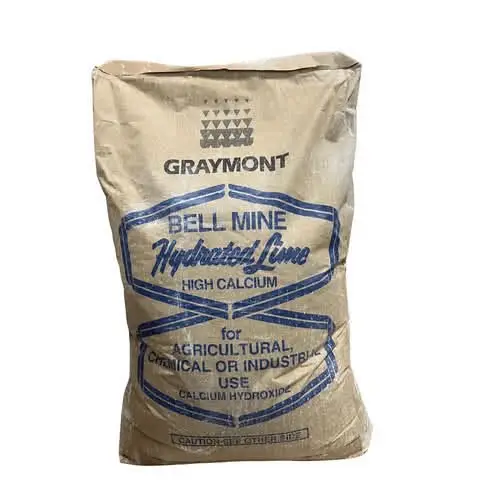
HYDRATED LIME FOR WATER TREATMENT
Hydrated lime, also known as calcium hydroxide, is an alkaline inorganic compound with the chemical formula Ca(OH)₂ and CAS number 1305-62-0. Manufacturers produce it by adding a controlled amount of water to quicklime, which results in a fine, white powder with strong neutralising properties.
Description
Hydrated Lime: Technical Description and Industrial Applications
Hydrated lime is a versatile inorganic chemical compound widely used in construction, water treatment, agriculture, manufacturing and industrial maintenance. Manufacturers produce it by reacting quicklime with carefully controlled quantities of water. This process, known as slaking, converts calcium oxide into calcium hydroxide, resulting in a fine, dry, white powder with strong alkaline properties.
Chemically, hydrated lime consists primarily of calcium hydroxide, represented by the formula Ca(OH)₂. It provides an effective source of calcium and alkalinity in numerous industrial and commercial processes. Furthermore, its ability to neutralise acids, regulate pH, improve material stability and support chemical reactions makes it an important raw material across several industries.
Unlike quicklime, which reacts vigorously with water and generates considerable heat, hydrated lime has already undergone the hydration process. Consequently, it offers easier handling and more convenient application in many construction and industrial operations. However, users must still follow appropriate handling procedures because its high alkalinity can irritate or damage the skin, eyes and respiratory system.
Physical and Chemical Properties of Hydrated Lime
Hydrated lime possesses several characteristics that make it suitable for demanding industrial and construction applications.
| Property | Typical characteristic |
|---|---|
| Chemical name | Calcium hydroxide |
| Chemical formula | Ca(OH)₂ |
| CAS number | 1305-62-0 |
| Appearance | Fine white powder |
| Molecular weight | 74.09 g/mol |
| Nature | Strongly alkaline |
| pH | Approximately 12.4 in a saturated aqueous solution at 25°C |
| Solubility | Slightly soluble in water |
| Density | Approximately 2.2–2.3 g/cm³ (true density) |
| Thermal behaviour | Decomposes at elevated temperatures |
| Main chemical function | Acid neutralisation and pH adjustment |
Advantages of Using Hydrated Lime
Hydrated lime offers several operational and economic advantages across different industries.
Effective pH control: Its alkaline properties allow operators to neutralise acidic substances and adjust pH levels.
Versatile applications: Businesses can use suitable grades in construction, water treatment, agriculture and chemical manufacturing.
Calcium supply: It introduces calcium into chemical formulations and selected treatment processes.
Improved construction workability: It enhances the plasticity and water retention of appropriate mortar and plaster mixtures.
Environmental applications: It helps remove acidic gases and neutralise industrial wastewater.
Convenient handling: Its powdered form allows controlled dosing, mixing and distribution using suitable equipment.
Commercial availability: Manufacturers supply different grades to meet varying industrial and commercial requirements.
Recommended storage practices
Store bags in a cool, dry and well-ventilated warehouse.
Keep the material away from rain and ground moisture.
Place bags on pallets rather than directly on concrete floors.
Seal opened bags tightly after use.
Avoid storage near acids and incompatible chemicals.
Maintain proper stock rotation to preserve product quality.





Reviews
There are no reviews yet.