
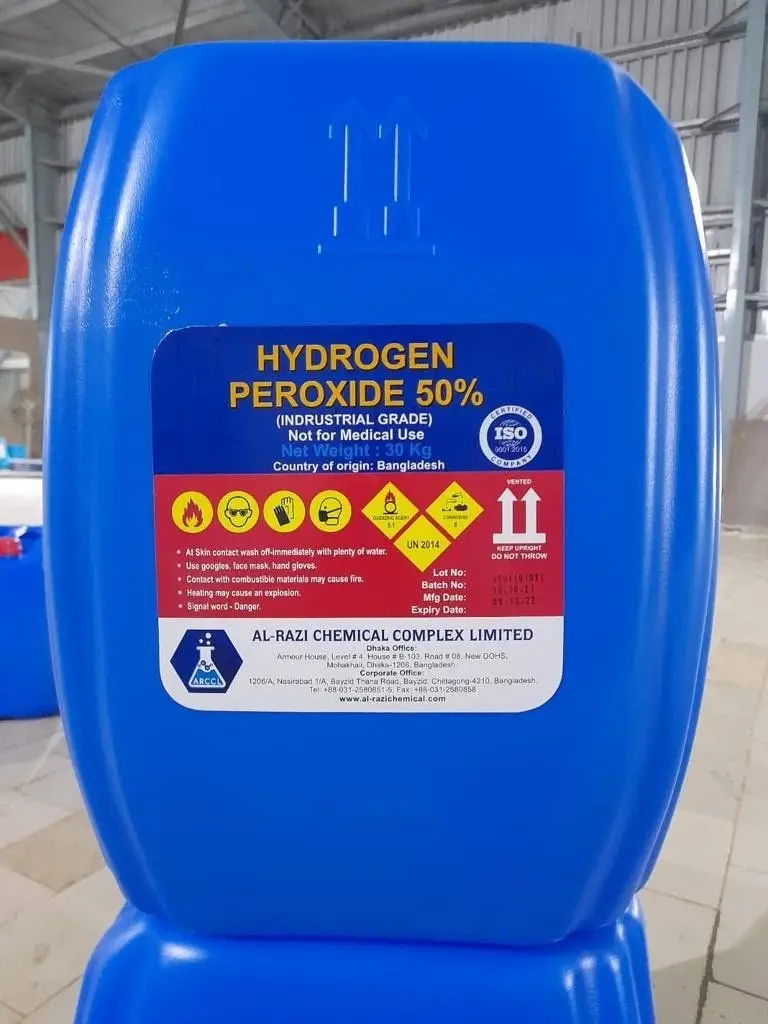
HYDROGEN PEROXIDE FOR WATER TREATMENT
Hydrogen peroxide is a versatile industrial chemical widely used in water treatment, cleaning, bleaching, sanitation and manufacturing. It consists of hydrogen and oxygen, with the chemical formula H₂O₂. In its pure form, it is a clear, colourless liquid that mixes completely with water. Moreover, it acts as a powerful oxidising agent, making it suitable for various industrial processes. When hydrogen peroxide decomposes under suitable conditions, it produces water and oxygen. Therefore, many industries use it where effective oxidation and controlled chemical treatment are essential.
Description
Industrial Hydrogen Peroxide for Water Treatment, Cleaning and Manufacturing
Hydrogen peroxide is a versatile industrial chemical widely used in water treatment, sanitation, manufacturing, healthcare, food processing and environmental management. It is a powerful oxidising agent that helps remove contaminants, control microorganisms, eliminate unwanted odours and improve the quality of industrial processes. Moreover, its ability to decompose into water and oxygen makes it an important alternative to certain chlorine-based chemicals in applications where reduced chemical residues matter.
Chemically, hydrogen peroxide has the molecular formula H₂O₂. It consists of two hydrogen atoms and two oxygen atoms connected by a single oxygen–oxygen bond. In its pure form, it is a pale blue liquid. However, commercial hydrogen peroxide usually appears as a clear, colourless solution because manufacturers supply it in different concentrations for specific applications. These concentrations determine its oxidising strength, handling requirements and suitability for different industrial operations.
Consequently, manufacturers, water treatment companies, cleaning contractors and industrial maintenance professionals use hydrogen peroxide to support demanding chemical processes. Its effectiveness, versatility and relatively clean decomposition products make it an important chemical for modern industrial applications.
Chemical Composition and Oxidising Properties
Hydrogen peroxide belongs to the peroxide family of chemical compounds. Unlike ordinary water, which contains one oxygen atom per molecule, hydrogen peroxide contains an additional oxygen atom. This structural difference gives it strong oxidising properties.
When hydrogen peroxide reacts with another substance, it can transfer oxygen and promote oxidation. As a result, it helps break down organic contaminants, oxidise dissolved iron and manganese, remove certain sulphide compounds and destroy microorganisms under appropriate treatment conditions.
Furthermore, hydrogen peroxide naturally decomposes according to the following chemical equation:
This reaction produces water and oxygen gas. Therefore, hydrogen peroxide can offer an advantage in applications where conventional disinfectants or oxidising chemicals may leave unwanted chemical residues. However, its decomposition rate increases in the presence of heat, light, alkalis and certain metal contaminants. Proper storage and handling are consequently essential.
Commercial Concentrations and Available Grades
Hydrogen peroxide is available in several concentrations. Each grade serves a different purpose depending on the required oxidising strength, purity and operating conditions.
| Concentration | Common applications |
|---|---|
| 3% | General cleaning and selected disinfection applications |
| 6% | Hair bleaching and specialised cleaning formulations |
| 10% | Selected industrial and commercial applications |
| 30% | Industrial oxidation and chemical processing |
| 35% | Food-processing applications where specifically approved, and industrial operations |
| 50% | Industrial bleaching, oxidation and wastewater treatment |
| 60% | Heavy industrial processing and specialised chemical manufacturing |
| 70% | Specialised high-strength industrial applications |
Important: These are representative commercial concentrations, not interchangeable grades. Food-processing applications require appropriate food-grade certification and regulatory approval. Similarly, the concentration alone does not establish product purity or suitability.
Hydrogen peroxide serves several important industries because it combines bleaching, oxidation, disinfection and contaminant-removal capabilities.
1. Water Treatment and Wastewater Management
Water treatment companies use hydrogen peroxide to oxidise dissolved contaminants and improve water quality. For example, it helps oxidise iron, manganese and hydrogen sulphide under suitable treatment conditions.
Additionally, treatment facilities use it to control unwanted odours, reduce certain organic pollutants and support advanced oxidation processes. When combined with ozone, hydrogen peroxide can generate highly reactive hydroxyl radicals that break down difficult organic contaminants.
Consequently, industrial wastewater facilities, municipal treatment plants and selected commercial water-treatment operations use hydrogen peroxide as an important treatment chemical.
2. Industrial Cleaning and Disinfection
Hydrogen peroxide provides oxidising and antimicrobial action against a range of microorganisms. Therefore, manufacturers incorporate suitable concentrations into selected cleaning and disinfection formulations.
It is particularly useful for cleaning processing equipment, sanitising compatible surfaces and controlling microbial contamination. Moreover, food-processing and pharmaceutical facilities use appropriately formulated hydrogen peroxide products for specialised sanitation and packaging-line disinfection.
However, users must follow the required contact time, concentration and application instructions to achieve the intended results.
3. Textile and Fabric Manufacturing
Textile manufacturers use hydrogen peroxide as a bleaching agent for cotton, wool and other compatible textile materials. It removes unwanted natural colour compounds and helps prepare fabrics for subsequent dyeing and finishing operations.
Unlike some traditional chlorine-based bleaching processes, hydrogen peroxide can decompose into water and oxygen. Consequently, it offers advantages in textile processing where manufacturers want to minimise certain chemical residues.
4. Paper and Pulp Manufacturing
The paper industry represents one of the largest industrial markets for hydrogen peroxide. Manufacturers use it to bleach wood pulp, improve paper brightness and process recycled paper.
Furthermore, recycling facilities use it during deinking operations to improve the appearance and quality of recovered paper fibres. Its oxidising action also supports the removal of selected colour-forming contaminants.
5. Food Processing and Packaging
Food-processing companies use specially manufactured hydrogen peroxide grades for approved sanitation and aseptic packaging applications. For instance, packaging facilities may apply hydrogen peroxide to compatible packaging materials before filling operations.
This process helps reduce microbial contamination and maintain hygienic packaging conditions. Nevertheless, food-grade certification, approved processing procedures and appropriate residual-control requirements remain essential.
6. Chemical Manufacturing
Chemical manufacturers use it as a raw material and processing reagent. Its oxidation properties support the production of various chemical intermediates and specialised compounds.
Additionally, manufacturers use it in selected organic synthesis, chemical modification and industrial purification processes. Its versatility makes it valuable in operations that require controlled oxidation.
7. Environmental Remediation
Environmental contractors use hydrogen peroxide in selected soil and groundwater remediation projects. It can help oxidise certain organic pollutants and other contaminants.
Furthermore, engineers incorporate it into advanced oxidation treatment systems to improve the breakdown of difficult chemical pollutants. However, the effectiveness of these processes depends on soil conditions, contaminant characteristics, chemical dosage and reaction time.
The following properties help distinguish hydrogen peroxide from other commonly used industrial chemicals.
| Property | Description |
|---|---|
| Chemical name | Hydrogen peroxide |
| Molecular formula | H₂O₂ |
| CAS number | 7722-84-1 |
| Molecular weight | 34.015 g/mol |
| Appearance | Clear, colourless liquid |
| Odour | Slightly sharp |
| Solubility | Completely miscible with water |
| Chemical classification | Inorganic peroxide |
| Chemical behaviour | Strong oxidising agent |
| Decomposition products | Water and oxygen |
| Commercial form | Aqueous solution |
| Storage requirement | Compatible, approved chemical containers |
Storage, Handling and Industrial Safety
Although hydrogen peroxide offers numerous industrial advantages, its oxidising properties demand careful handling. In particular, concentrated solutions can cause serious chemical burns and eye injuries.
Therefore, industrial users should observe the following precautions:
Store hydrogen peroxide in approved, compatible and properly labelled containers.
Protect the chemical from direct sunlight and excessive heat.
Avoid contamination with iron, copper, rust, organic materials and incompatible chemicals.
Use appropriate chemical-resistant gloves, protective clothing and eye protection.
Provide adequate ventilation in storage and handling areas.
Never return unused chemical to its original container.
Keep it away from combustible materials, reducing agents and incompatible substances.
Follow the manufacturer’s Safety Data Sheet (SDS) for storage temperatures and handling procedures.
Importantly, hydrogen peroxide is not itself a conventional combustible fuel. However, its strong oxidising action can intensify combustion and cause dangerous reactions when it contacts incompatible materials. Furthermore, decomposition releases oxygen and heat, potentially increasing pressure inside sealed containers.
For these reasons, industrial users should never transfer concentrated hydrogen peroxide into ordinary, unapproved storage containers.
Hydrogen peroxide remains an important industrial chemical because it performs several functions within one chemical formulation. It supports bleaching, oxidation, wastewater treatment, disinfection and specialised manufacturing operations.
Moreover, its decomposition into water and oxygen makes it attractive for processes where certain conventional chemical residues are undesirable. Nevertheless, industrial buyers must select the correct concentration, purity and grade for each application.
Businesses seeking reliable hydrogen peroxide supplies should therefore consider the intended application, technical specifications, packaging compatibility and supplier documentation before purchasing.
Whether used in water treatment, industrial cleaning, textile bleaching, paper manufacturing or chemical processing, hydrogen peroxide provides a versatile solution for demanding industrial operations.
Related products
-


- Sale!

Caustic Soda in Kenya
Original price was: KSh 5,700.00.KSh 4,350.00Current price is: KSh 4,350.00. -

-





Reviews
There are no reviews yet.