
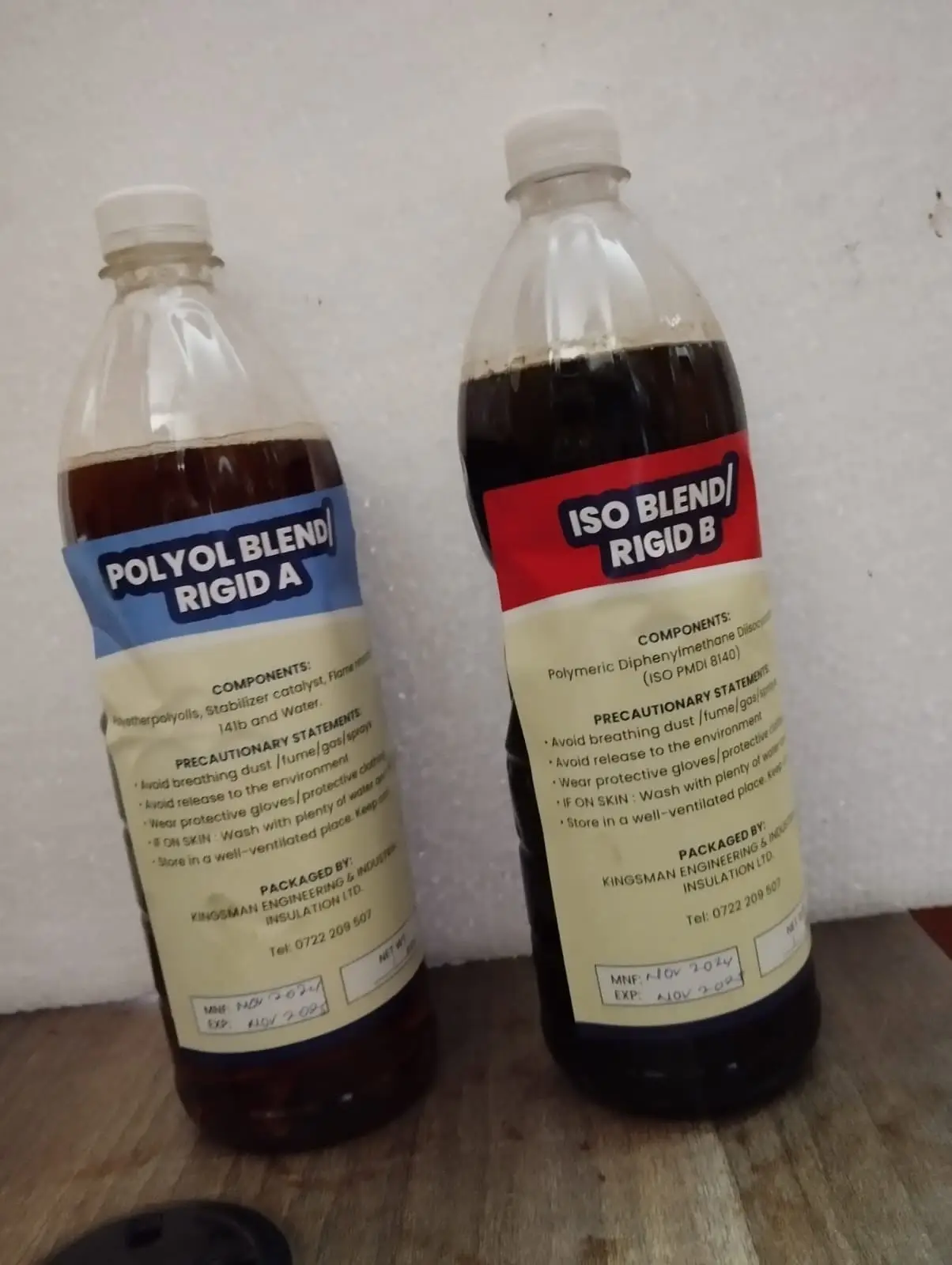
Polyurethane foam (PU foam)
Polyurethane (PU) Foam – Technical Description
Polyurethane (PU) foam is a cellular polymeric material produced by reacting polyols with isocyanates in the presence of catalysts, blowing agents, surfactants and other additives. The reaction generates a foam structure consisting of interconnected or closed cells, providing excellent thermal insulation, acoustic absorption, cushioning and sealing properties.
Description
PU Foam – Technical Description, Applications, Properties and Uses
Polyurethane foam (PU foam) is a versatile polymer-based material that provides effective insulation, sealing, cushioning and gap-filling solutions across construction, industrial maintenance, refrigeration and manufacturing applications. Manufacturers produce PU foam through a chemical reaction between polyols and isocyanates. During this reaction, the material expands and forms a cellular structure that delivers excellent thermal insulation, sound absorption and sealing performance. Consequently, PU foam has become an important material for controlling heat transfer, preventing air leakage and filling unwanted spaces in buildings and industrial installations.
1. What Is Polyurethane Foam?
Polyurethane foam is a lightweight cellular polymer that contains numerous small gas-filled cells. These cells give the material its characteristic insulating and cushioning properties. Depending on its formulation, manufacturers produce either flexible or rigid polyurethane foam to meet different technical requirements.
Furthermore, PU foam is available in several forms, including spray foam, expanding foam, rigid foam boards, flexible foam sheets and preformed insulation products. However, one-component expanding PU foam is particularly useful for construction, installation and general maintenance because users can apply it directly from a pressurised aerosol can.
When exposed to atmospheric moisture, the foam undergoes a curing process. As a result, it expands, fills available spaces and gradually develops a stable cellular structure. This expansion allows PU foam to seal irregular openings that conventional sealing materials may struggle to cover effectively.
2. Technical Composition and Expansion Mechanism
Polyurethane foam forms through a chemical reaction involving two principal components: polyols and isocyanates. Manufacturers combine these substances with suitable catalysts, blowing agents, surfactants and other additives to control expansion, curing time, density and final performance.
In one-component PU foam, atmospheric moisture initiates and supports the curing reaction. Meanwhile, the blowing agent helps generate the cellular structure responsible for expansion.
Consequently, freshly dispensed foam increases in volume before hardening. Depending on the formulation, application conditions and product specifications, the expansion rate can vary considerably.
Importantly, users should distinguish between free expansion and post-expansion. Free expansion describes the volume increase when foam expands without significant confinement. Conversely, post-expansion refers to additional expansion during the curing process. Therefore, installers should avoid overfilling cavities because excessive expansion can exert pressure on surrounding materials.
3. Key Technical Properties of PU Foam
PU foam offers several functional properties that make it suitable for demanding installation and maintenance applications.
Thermal insulation: Its cellular structure restricts heat transfer by reducing conduction and air movement. Therefore, PU foam helps improve thermal efficiency around window frames, door installations, roof structures, walls and service penetrations.
Air sealing: Expanding polyurethane foam fills gaps, joints and irregular openings. Consequently, it reduces unwanted air infiltration and helps improve building airtightness.
Sound absorption: The cellular structure can help reduce airborne sound transmission and absorb certain levels of noise. However, its acoustic performance depends on density, thickness and installation conditions.
Water resistance: Cured PU foam generally resists water absorption better than many conventional porous fillers. Nevertheless, standard expanding PU foam is not a substitute for a properly designed waterproofing membrane or continuous waterproofing system.
Lightweight structure: PU foam provides useful insulation and sealing performance without adding substantial weight to installations. This characteristic makes it suitable for construction, refrigeration and equipment installation.
Adhesion: PU foam adheres to many common building materials, including concrete, masonry, timber, metal and certain plastics. However, users should check compatibility before applying it to sensitive surfaces.
Dimensional stability: Properly cured foam maintains its cellular structure under normal service conditions. Nevertheless, temperature variations, ultraviolet exposure and mechanical stress can affect long-term performance.
4. Types of Polyurethane Foam
Different PU foam formulations serve different installation and industrial requirements.
One-component expanding PU foam: Manufacturers package this foam in pressurised cans. It expands after dispensing and cures through moisture exposure. Installers commonly use it for filling gaps, sealing openings and insulating around frames.
Two-component PU foam: This formulation uses two reactive components that produce a controlled curing reaction. It is useful where faster curing, specific density or specialised performance is required.
Rigid polyurethane foam: This type provides structural rigidity and excellent thermal insulation. Manufacturers widely use it in insulated panels, refrigeration equipment and building insulation systems.
Flexible polyurethane foam: This formulation provides cushioning and resilience. Consequently, manufacturers use it in furniture, mattresses, automotive seating and packaging.
Spray polyurethane foam: Contractors apply this material through specialised spraying equipment to create continuous insulation and air-sealing layers across suitable surfaces.
5. Major Applications of PU Foam
PU foam serves several construction, industrial and commercial applications because of its expansion, insulation and sealing characteristics.
Building and construction: Contractors use expanding PU foam to fill spaces around windows, doors, wall penetrations and building joints. Additionally, they apply suitable formulations around electrical and plumbing service openings where product specifications permit.
Roofing and insulation: PU foam helps seal selected roof penetrations, joints and insulation gaps. Furthermore, spray polyurethane systems provide thermal insulation across suitable roof assemblies.
Refrigeration and cold storage: Rigid polyurethane foam provides thermal insulation in cold rooms, refrigerated transport equipment, freezers and insulated panels. Its low thermal conductivity helps minimise heat transfer and maintain controlled temperatures.
Plumbing and pipe installations: Installers use expanding foam to fill openings around service pipes and conduits. However, they must use appropriate products and installation methods where pipes experience vibration, thermal movement or high operating temperatures.
Industrial maintenance: Maintenance teams apply PU foam to seal selected openings, reduce air leakage and fill irregular cavities around equipment installations. Nevertheless, they should select formulations that withstand the actual operating environment.
Packaging and cushioning: Flexible polyurethane foam provides cushioning and impact protection for delicate equipment, machinery components and other packaged products.
6. Advantages of Using PU Foam
PU foam offers several practical advantages over conventional gap-filling and insulation materials.
Excellent gap-filling capability: Its expanding nature allows it to reach irregular spaces and difficult-to-access openings.
Improved thermal efficiency: Its cellular structure reduces heat transfer across properly insulated areas.
Reduced air infiltration: It seals openings that could otherwise allow uncontrolled air movement.
Convenient application: Aerosol-based products allow users to apply foam directly without complex machinery.
Strong adhesion: Suitable formulations bond to several common construction substrates.
Lightweight installation: The material adds relatively little weight to building and equipment assemblies.
Versatile applications: Different formulations support construction, insulation, refrigeration, packaging and industrial maintenance.
7. Application Procedure and Installation Guidelines
Correct application determines the quality, durability and performance of polyurethane foam installations. Therefore, users should follow the manufacturer’s technical data sheet.
First, clean the application surface and remove loose particles, dust, grease and other contaminants. Next, lightly moisten suitable mineral surfaces where the product manufacturer recommends moisture-assisted curing.
Afterwards, shake the aerosol can thoroughly and attach the dispensing nozzle. Apply the foam gradually into the opening while allowing sufficient space for expansion. In particular, avoid filling the entire cavity because the material increases in volume during curing.
Allow the foam to cure according to the manufacturer’s recommended timeframe. Subsequently, trim excess material using a suitable cutting tool. Finally, protect exposed foam against direct sunlight, ultraviolet radiation, moisture exposure where relevant and mechanical damage.
Important safety consideration: Uncured polyurethane foam can contain reactive isocyanates. Therefore, users should wear appropriate gloves, eye protection and suitable respiratory protection as specified by the safety data sheet. They should also provide adequate ventilation and keep uncured foam away from ignition sources.
8. Limitations and Technical Considerations
Although PU foam offers excellent insulation and sealing properties, users must understand its limitations.
Firstly, standard polyurethane foam is not inherently fireproof. Consequently, applications requiring fire resistance demand appropriately tested fire-rated products and approved installation systems.
Secondly, ultraviolet radiation can degrade exposed polyurethane foam over time. Therefore, installers should cover exposed surfaces with compatible protective coatings, plaster, cladding or other approved finishes.
Additionally, standard expanding foam does not automatically provide structural support. Users should not substitute it for structural grout, concrete, mechanical fasteners or engineered load-bearing materials.
Finally, PU foam is not universally compatible with every plastic, coating or chemical environment. Thus, installers should confirm material compatibility before application.
9. Choosing the Right PU Foam
Selecting the correct polyurethane foam requires consideration of the intended application, expansion rate, curing characteristics, density, adhesion and environmental exposure.
For example, window and door installations require products that provide effective sealing without exerting excessive expansion pressure on frames. Conversely, refrigeration applications demand insulation materials with suitable thermal performance and long-term dimensional stability.
Similarly, industrial environments may require specialised formulations with defined fire performance, temperature resistance or chemical compatibility. Therefore, buyers should evaluate technical specifications rather than relying on product descriptions alone.
10. Buy Quality PU Foam in Kenya
Whether you need polyurethane foam for construction, window installation, refrigeration, insulation or industrial maintenance, selecting the correct formulation makes a significant difference to installation quality and long-term performance.
Maavaroz Industrial Limited supplies industrial and construction materials, including practical sealing and insulation solutions for commercial and industrial applications. We focus on providing suitable products for different project requirements while supporting customers with product selection and supply enquiries.
Contact Maavaroz Industrial Limited today for PU foam supply, product specifications, technical guidance and competitive quotations in Kenya
Related products
-


-

- Sale!

Soda ash in Kenya
Original price was: KSh 4,500.00.KSh 3,700.00Current price is: KSh 3,700.00. -





Reviews
There are no reviews yet.